


Saham News
BBCA Shares Drop 2.25% as Foreign Investors Sell Rp419 Billion
/index.php
Bisnis | Ekonomi - Posted on 20 February 2026 Reading time 5 minutes
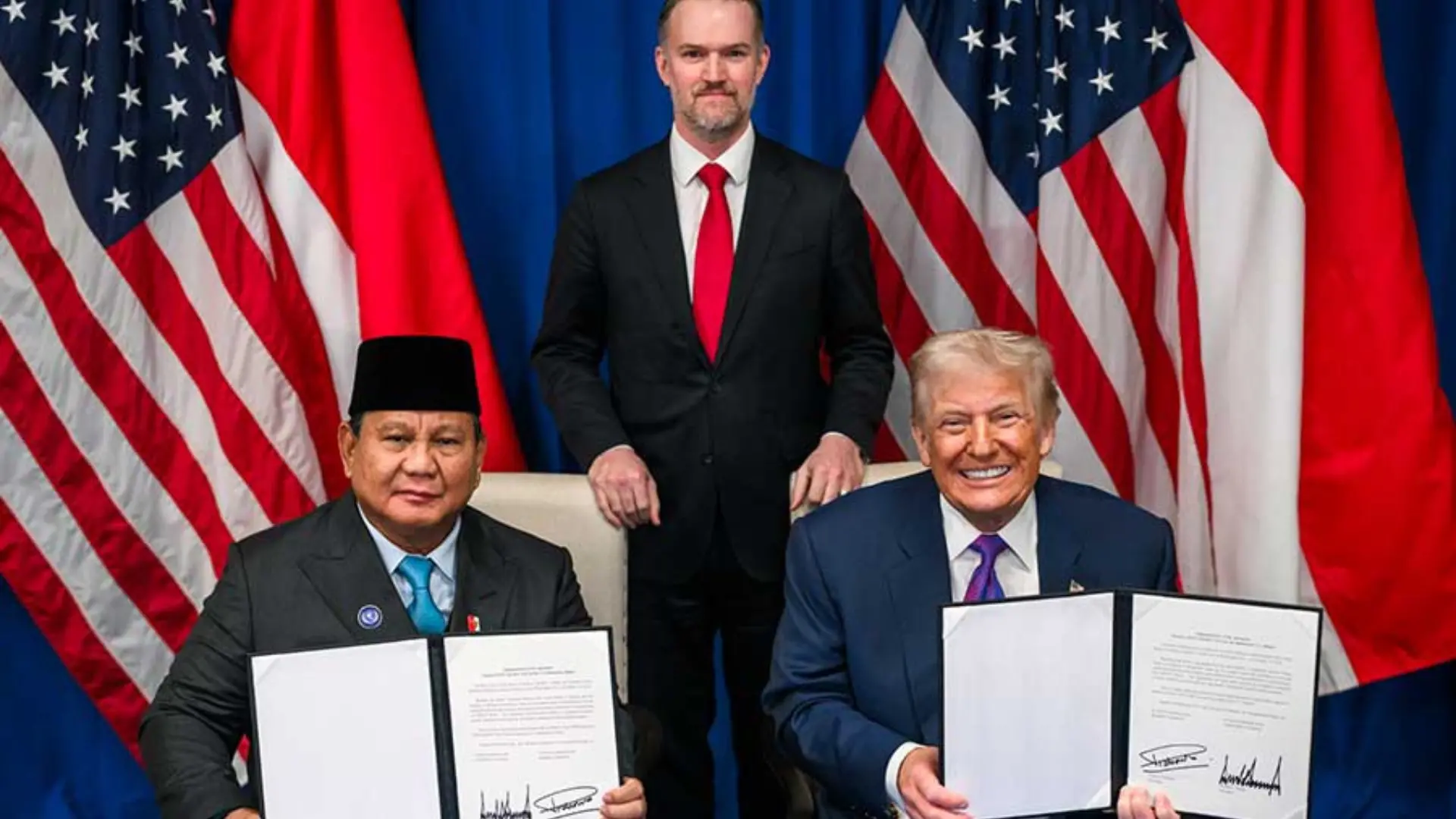
The trade agreement between Indonesia and the United States (US) is viewed by economists as potentially driving a significant increase in imports of agricultural products, energy, and aircraft. As a result, pressure is expected to shift toward the trade balance and the current account.
“This means short-term stability may be supported, but the quality of external financing becomes crucial because rising imports could affect the exchange rate, risk premiums, and investor sentiment,” said Rizal Taufikurahman, Head of the Center of Macroeconomics and Finance at Indef, when contacted on Friday (February 20, 2026).
Rizal considers the US tariff agreement more as a risk-containment measure rather than a new growth driver. According to him, the reduction of US tariffs to 19% from 32% may help prevent a contraction in Indonesian exports, particularly in labor-intensive manufacturing. However, since the tariff remains relatively high, Indonesia’s competitiveness has not changed substantially.
He argues that the most strategic element lies in the opening of the domestic market, including the relaxation of non-tariff barriers and digital taxation policies. In theory, this could lower input costs and enhance efficiency, but it may also narrow the space for industrial policy and protection of sectors that are not yet competitive, thereby posing a risk of premature deindustrialization.
“Therefore, the benchmark of success is not the tariff agreement itself, but whether Indonesia gains technology transfer, real investment, and productivity improvements,” he said. Without these elements, the trade deal risks becoming asymmetric, as Indonesia opens its market and increases imports while the benefits in terms of growth and domestic value added remain limited.
Bank Indonesia (BI) recently reported that the current account recorded a deficit of US$2.5 billion, equivalent to 0.7% of gross domestic product (GDP), in the fourth quarter of 2025. This marked a deterioration compared with the third quarter of 2025, which still posted a surplus of US$4 billion or 1.1% of GDP.
BI explained that the current account balance was influenced by a higher quarterly oil and gas trade deficit, which widened from US$4.9 billion to US$57 billion, in line with increased domestic economic activity.
For the full year of 2025, the current account recorded a deficit of US$1.5 billion or 0.1% of GDP, lower than the 2024 deficit of US$8.6 billion or 0.6% of GDP.
Meanwhile, Statistics Indonesia (BPS) reported that Indonesia’s goods trade balance posted a surplus of US$2.51 billion in December 2025, marking 68 consecutive months of surplus since May 2020.
Regarding the tariff arrangement, the Indonesian and US governments officially signed the reciprocal trade agreement, or agreement on reciprocal tariff (ART), on Thursday (February 19, 2026) local time.
The agreement includes commitments such as the purchase of 50 Boeing aircraft, imports of fuel, oil, and LPG, agricultural products including soybeans, corn, and beef, technology products, development of critical minerals, trade in furniture products, and semiconductor development.
However, Coordinating Minister for Economic Affairs Airlangga Hartarto stated that around 90% of the documents and proposals submitted by Indonesia had been accommodated by the US.
Airlangga added that both countries agreed to strengthen economic cooperation and promote sustainable economic growth. The agreement serves as a new foundation for managing trade and investment issues that have long been mutual concerns.
He explained that the main objective and vision of the agreement are to achieve shared economic prosperity and build a resilient supply chain. The government also emphasized that the cooperation is based on mutual respect for each country’s sovereignty as an essential part of the agreement.
“So I underline that respect for each country’s sovereignty is an integral part of the agreement that has been signed,” Airlangga stressed.
He also stated that the decision is expected to positively impact around 4 million workers in the textile sector and potentially benefit 20 million people involved in the product supply chain.
Source: bloombergtechnoz.com
What do you think about this topic? Tell us what you think. Don't forget to follow Digivestasi's Instagram, TikTok, Youtube accounts to keep you updated with the latest information about economics, finance, digital technology and digital asset investment.
DISCLAIMER
All information contained on our website is summarized from reliable sources and published in good faith and for the purpose of providing general information only. Any action taken by readers on information from this site is their own responsibility.
SHARE
VIEW


